
We're not the ones saying that we're fans of both teams. That was all you.Just like most grizzlies fans will be the biggest fan boys of the Bison in the FBS.. correct?.
Three teams run this board..

We're not the ones saying that we're fans of both teams. That was all you.Just like most grizzlies fans will be the biggest fan boys of the Bison in the FBS.. correct?.
Three teams run this board..

Again, $$$ is why Montana will never move up. I appreciate keeping hope alive more than anyone but you have to be a realist in some situations and the reality is Montana will never come up with the cash and a move up will be 100% dependent on the inviting conference to let us come in on an IOU.This is long and what i found.
The financial landscape of FBS (Football Bowl Subdivision) football in 2026 is reaching a "breaking point" as programs navigate the most radical economic shift in the history of college sports.
The primary driver of this crisis is the **House v. NCAA settlement**, which took effect in July 2025. For the first time, schools are allowed to share revenue directly with athletes (capped at roughly **$20.5 million** per year in 2026). While the elite programs are spending record amounts to keep up, many others are drowning in debt or cutting other sports to keep their football teams afloat.
### 1. Programs Currently Under Financial Duress
Recent financial reports (FY2025–26) highlight several major programs operating at significant deficits or carrying massive debt:
* **University of Houston:** Head coach Kelvin Sampson recently stated publicly that the department is **"broke."** Despite moving to the Big 12, the school is struggling with the high costs of the revenue-sharing era and NIL.
* **University of North Carolina (UNC):** Reported a **$15 million deficit** for the 2024–25 fiscal year. This is a sharp reversal for a program that had been profitable for years.
* **University of Texas:** Despite record revenues, Texas reported a **$23.4 million deficit** in 2025. This was largely due to the "buy-in" costs of moving to the SEC and a record $375 million in total spending.
* **Penn State:** Reported nearly **$535 million in athletics-related debt** in 2025, fueled by a $700 million renovation of Beaver Stadium.
* **Florida State:** Carries approximately **$437 million in debt**. Their aggressive legal push to leave the ACC is largely driven by the "revenue gap" between them and SEC/Big Ten schools.
### 2. The "Subsidized" Schools
Many mid-major FBS programs (Group of 5) and even some Power 4 schools rely heavily on student fees and institutional support to survive. Without these "hidden" subsidies, their football programs would be non-viable:
* **James Madison (JMU):** Student fees cover **73%** of their athletic budget.
* **Old Dominion (ODU):** Student fees cover **61%** of their budget.
* **Virginia Tech & Virginia:** Both rely on student fees for roughly **10–11%** of their funding.
### 3. The "Revenue-Sharing" Crisis
The 2026 season marks a "survival of the richest" era. Programs are facing three simultaneous financial pressures:
1. **The $20M Cap:** Schools that "opt-in" to the $20.5 million revenue share must find that money in existing budgets, often leading to layoffs and the cutting of "non-revenue" sports like tennis, swimming, or track.
2. **Roster Limits:** New NCAA rules have eliminated scholarship caps but replaced them with **roster limits**. This forces programs to decide whether to fund 105 full scholarships for football, which significantly increases costs.
3. **The Conference Gap:** SEC and Big Ten schools are receiving annual payouts of **$70M+**, while ACC and Big 12 schools are often making half that, creating a permanent underclass within the "Power 4."
### 4. Recent Program Cuts (2025–2026)
To keep football competitive, several schools have recently cut other programs or staff:
* **UTEP & ULM:** Cut women's tennis programs to save costs.
* **Texas A&M:** Implemented significant budget cuts to administrative staff to redirect funds toward the 2026 NIL and revenue-sharing model.
* **Saint Francis (PA):** Announced a transition from Division I to Division III effective Fall 2026, citing the unsustainable costs of D-I
Interesting seeing the Big Sky with 7th best market share there on that list ahead of A10 and Mountain West and several other group of 5. Article is from 2023. Wonder how much that has changed with the dissolution and more featured games on ESPN/ABC?Interesting info:
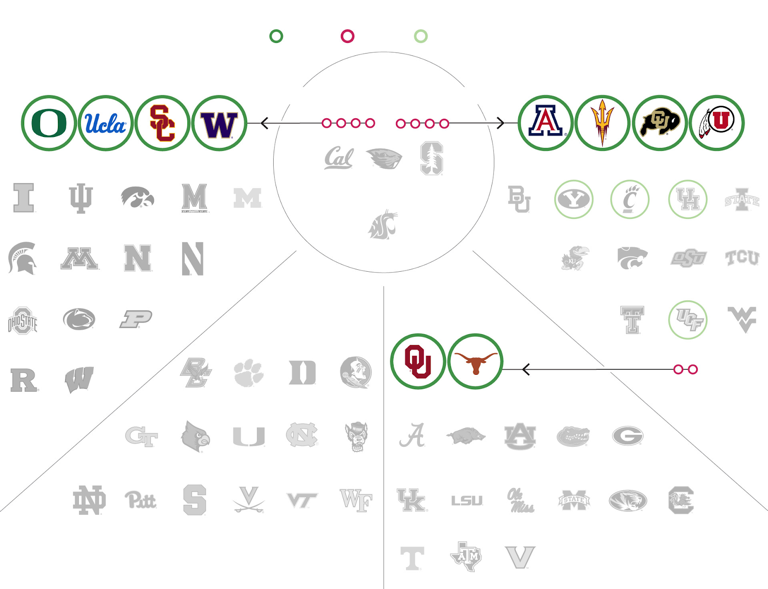
Game of Dollars: TV Deals Drive College Football Realignment - Cross Screen Media
Six big questions re: college football media $$$: 1) Why are teams switching conferences in college football? 2) What is the math behind Oregon and Washington moving to the...crossscreen.media
BSU beat you to it, but i still will root for y'all just like most all the other good FCS teams to move up over the years.Just like most grizzlies fans will be the biggest fan boys of the Bison in the FBS.. correct?.
Three teams run this board..
Forever, because they are not. Doesnt change a thing.So how long will it take you to say out loud to fellow NDSU fans the Montana is your favorite FCS tesm?
Really? If not a fan of the Bison only one other reason for all the threads over the years.. has to be envy then for all those National Championships NDSU has earned, right?We're not the ones saying that we're fans of both teams. That was all you.
Seek help, professional helpReally? If not a fan of the Bison only one other reason for all the threads over the years.. has to be envy then for all those National Championships NDSU has earned, right?

In correct!Just like most grizzlies fans will be the biggest fan boys of the Bison in the FBS.. correct?.
Three teams run this board..
has to be pisstivity then for all those National Championships NDSU has bought, right?Really? If not a fan of the Bison only one other reason for all the threads over the years.. has to be envy then for all those National Championships NDSU has earned, right?

If UM substantially increased the student fees, institutional support and state support to be on par with teams like UCD or SSU there would be enough revenue to fund a move up. The problem is the Montana tax payers and students would not have the stomach for that. Also if you try to soak the students, the fees would have to be substantial. UM has the smallest enrollment in the BSC let alone the MWC, which makes it difficult. FCS/IAA is the equivalent of Div II before FCS/IAA was created. The griz are still at the same level as they were in the Div II days. It just gives people a warm fuzzy to call themselves Div I. But the only thing that has changed is that a stream of teams have moved up the chain. The griz have largely benefited from that. A ton of teams moved on prior to 1995 or the griz probably wouldn't have their two NC.Again, $$$ is why Montana will never move up. I appreciate keeping hope alive more than anyone but you have to be a realist in some situations and the reality is Montana will never come up with the cash and a move up will be 100% dependent on the inviting conference to let us come in on an IOU.
Anyone who thinks there's a chance, please explain where we will get the $ from in house.
FCS is NOT like D2 before FCS was created. D2 still exists. A huge amount has changed from D2 days. Much better competition in FCS. A large number of football and other scholarships in FCS. Larger stadiums. A larger number of sports, I assume but don't know. More attendance. The teams moving on before 1995 didn't win national championships. Boise State win in 1980, at the Grizzlies beat them 45-28 in 1995. Your statement on that subject is wrong. Playing in FCS means that basketball and the other UM sports are playing in D1, not D2. My god, how could you be so wrong?If UM substantially increased the student fees, institutional support and state support to be on par with teams like UCD or SSU there would be enough revenue to fund a move up. The problem is the Montana tax payers and students would not have the stomach for that. Also if you try to soak the students, the fees would have to be substantial. UM has the smallest enrollment in the BSC let alone the MWC, which makes it difficult. FCS/IAA is the equivalent of Div II before FCS/IAA was created. The griz are still at the same level as they were in the Div II days. It just gives people a warm fuzzy to call themselves Div I. But the only thing that has changed is that a stream of teams have moved up the chain. The griz have largely benefited from that. A ton of teams moved on prior to 1995 or the griz probably wouldn't have their two NC.

Who?If UM substantially increased the student fees, institutional support and state support to be on par with teams like UCD or SSU there would be enough revenue to fund a move up. The problem is the Montana tax payers and students would not have the stomach for that. Also if you try to soak the students, the fees would have to be substantial. UM has the smallest enrollment in the BSC let alone the MWC, which makes it difficult. FCS/IAA is the equivalent of Div II before FCS/IAA was created. The griz are still at the same level as they were in the Div II days. It just gives people a warm fuzzy to call themselves Div I. But the only thing that has changed is that a stream of teams have moved up the chain. The griz have largely benefited from that. A ton of teams moved on prior to 1995 or the griz probably wouldn't have their two NC.
And Nevada never won a national championship, I don't think,Who?
Akron? They were never an FCS powerhouse.
Arkansas State? They were decent in the 80's but absolutely sucked in the late 80's and early 90's when they moved up.
LA Tech? They had some strong teams in the early 90's, but were fairly mediocre before they moved up.
LA Monroe? Not exactly a powerhouse before or after moving up, either.
North Texas? They were bad to mediocre until they moved up, then were just bad.
Nevada is probably the only team I might agree with you on, they were really good, but one team is not "a ton".
I was agreement with you till you swerved off the cliff at the end there.If UM substantially increased the student fees, institutional support and state support to be on par with teams like UCD or SSU there would be enough revenue to fund a move up. The problem is the Montana tax payers and students would not have the stomach for that. Also if you try to soak the students, the fees would have to be substantial. UM has the smallest enrollment in the BSC let alone the MWC, which makes it difficult. FCS/IAA is the equivalent of Div II before FCS/IAA was created. The griz are still at the same level as they were in the Div II days. It just gives people a warm fuzzy to call themselves Div I. But the only thing that has changed is that a stream of teams have moved up the chain. The griz have largely benefited from that. A ton of teams moved on prior to 1995 or the griz probably wouldn't have their two NC.

And guilt by association with Kaepernick.And Nevada never won a national championship, I don't think,
by extension, anything you've been involved with has guilt by association.And guilt by association with Kaepernick.
The Griz are 4-10 vs Nevada, 9-16 vs BSU and 31-56 vs Idaho.
This is long and what i found.
The financial landscape of FBS (Football Bowl Subdivision) football in 2026 is reaching a "breaking point" as programs navigate the most radical economic shift in the history of college sports.
The primary driver of this crisis is the **House v. NCAA settlement**, which took effect in July 2025. For the first time, schools are allowed to share revenue directly with athletes (capped at roughly **$20.5 million** per year in 2026). While the elite programs are spending record amounts to keep up, many others are drowning in debt or cutting other sports to keep their football teams afloat.
### 1. Programs Currently Under Financial Duress
Recent financial reports (FY2025–26) highlight several major programs operating at significant deficits or carrying massive debt:
* **University of Houston:** Head coach Kelvin Sampson recently stated publicly that the department is **"broke."** Despite moving to the Big 12, the school is struggling with the high costs of the revenue-sharing era and NIL.
* **University of North Carolina (UNC):** Reported a **$15 million deficit** for the 2024–25 fiscal year. This is a sharp reversal for a program that had been profitable for years.
* **University of Texas:** Despite record revenues, Texas reported a **$23.4 million deficit** in 2025. This was largely due to the "buy-in" costs of moving to the SEC and a record $375 million in total spending.
* **Penn State:** Reported nearly **$535 million in athletics-related debt** in 2025, fueled by a $700 million renovation of Beaver Stadium.
* **Florida State:** Carries approximately **$437 million in debt**. Their aggressive legal push to leave the ACC is largely driven by the "revenue gap" between them and SEC/Big Ten schools.
### 2. The "Subsidized" Schools
Many mid-major FBS programs (Group of 5) and even some Power 4 schools rely heavily on student fees and institutional support to survive. Without these "hidden" subsidies, their football programs would be non-viable:
* **James Madison (JMU):** Student fees cover **73%** of their athletic budget.
* **Old Dominion (ODU):** Student fees cover **61%** of their budget.
* **Virginia Tech & Virginia:** Both rely on student fees for roughly **10–11%** of their funding.
### 3. The "Revenue-Sharing" Crisis
The 2026 season marks a "survival of the richest" era. Programs are facing three simultaneous financial pressures:
1. **The $20M Cap:** Schools that "opt-in" to the $20.5 million revenue share must find that money in existing budgets, often leading to layoffs and the cutting of "non-revenue" sports like tennis, swimming, or track.
2. **Roster Limits:** New NCAA rules have eliminated scholarship caps but replaced them with **roster limits**. This forces programs to decide whether to fund 105 full scholarships for football, which significantly increases costs.
3. **The Conference Gap:** SEC and Big Ten schools are receiving annual payouts of **$70M+**, while ACC and Big 12 schools are often making half that, creating a permanent underclass within the "Power 4."
### 4. Recent Program Cuts (2025–2026)
To keep football competitive, several schools have recently cut other programs or staff:
* **UTEP & ULM:** Cut women's tennis programs to save costs.
* **Texas A&M:** Implemented significant budget cuts to administrative staff to redirect funds toward the 2026 NIL and revenue-sharing model.
* **Saint Francis (PA):** Announced a transition from Division I to Division III effective Fall 2026, citing the unsustainable costs of D-I
