Sports is filled with all sorts of anomalies. Take San Francisco Giants pitcher Tim Lincecum as an example. He's a power-pitching, two-time Cy Young Award winner who stands 5-foot-10 and weighs 170 pounds soaking wet, yet throws in the mid-90s. In the NBA, Spud Webb and Muggsy Bogues darted their way through basketball redwoods en route to successful careers (and even won a slam dunk contest along the way) yet averaged a meager 5-foot-5.
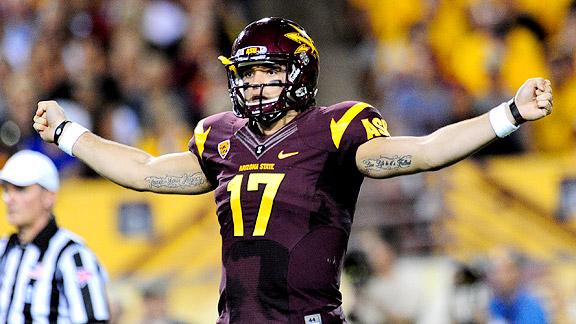
College football features an anomaly of its own, a Kalispell, Mont., native who is standing extra tall among the cacti of the Arizona desert. Brock Osweiler is much more than a former Gonzaga basketball commit turned Arizona State Sun Devils starting quarterback. He is a 6-8, 240-pound post player running point guard for an up-tempo, fast-break offense.
Osweiler might seem like an unlikely candidate to be directing the no-huddle, zone-read, basketball-on-grass offensive system employed by ASU offensive coordinator Noel Mazzone and many other programs around the country. But he and Mazzone have developed together to not only overcome some of the challenges created by Osweiler's size but also exploit the advantages that come from it, turning him into one of the most unique offensive weapons in all of college football. Here's how they've done it and why Osweiler has a decent chance to do Saturday night what no quarterback has been able to in more than three seasons: beat the Oregon Ducks in Eugene.
Three factors will work in Osweiler's favor as he takes the Autzen Stadium field.
1. Size
First and foremost, Osweiler is massive. If Ben Roethlisberger looks imposing to a defensive front seven, Osweiler must look like Paul Bunyan, ready to wield his mighty ax. Brock is not lean and lanky; he is power-forward strong and supported by a weighty base that is unwavering through contact. (For perspective, Osweiler's listed measurables are in the Carmelo Anthony/LeBron James range.)
Osweiler leverages his size and strength and doesn't shy away from contact. This will come into play on Saturday night against Nick Aliotti's blitz-happy Oregon defense, as he can expect there to be more Ducks defenders on the attack than he will have protectors on many passing downs. For the Sun Devils' offense to be effective, Osweiler will need to shed blitzers with his strength and function with defenders draped all over him.
2. Vision
Osweiler hasn't thrown 13 touchdown passes and averaged 280 passing yards per game purely based on his size affording him opportunities to play through contact. More importantly, his height allows him the vision to see everything a defense is throwing his way -- before and after the snap. Whereas most quarterbacks will have at least one time this season when they get on the phone with their offensive coordinator after an interception and say, "Sorry, Coach, I just couldn't see the safety tipping his hand to the blitz pre-snap," Osweiler doesn't have that challenge. With his height, he can scan and see over all his linemen, dissecting the tendencies of not just the front seven but also the members of the defensive secondary.
If the Sun Devils are to outscore the Ducks Saturday night, Osweiler's ability to see and recognize the blitz, change protections and get the ball out quickly to his playmakers will prove vital.
3. Quick release
Getting the ball out quickly is physical as much as it is mental, however, and this is another area in which Osweiler has shown great improvement. The reason that only one quarterback of Osweiler's frame has started games in the NFL is fairly simple. Like most 6-8 quarterbacks, Dan McGwire was too big and too slow to succeed in the NFL, and even though he had a howitzer for an arm, it took so long to fire the gun that it was ineffective.
This is where Dennis Erickson and Mazzone, along with Osweiler, deserve a lot of credit. Osweiler has a shortened pass release; in essence, he is a 6-8 passer with a 6-3 release. The throwing motion is compact and much quicker than one would expect from a long-levered thrower. "He's spent a lot of time changing his throwing motion," Erickson said in a Sports Illustrated article in August. "He's getting the ball out of his hand a lot better than he did. He's much more accurate now."
The best comparison is to take a golfer with a really long, powerful swing and convert that process to a three-quarter, extra-efficient, repeatable movement. Does the drive lose a little yardage? Sure, but the increase the golfer will get in accuracy and consistency makes it worthwhile.
Plus, although golfers don't have to worry about time and pass-rushers, quarterbacks do. That's why a quick release is essential. The adjustments Osweiler has made have created a throwing motion that isn't pretty. (It's something that NFL scouts will want to see cleaned up as he goes through the evaluation process next year, his senior season; as of right now, he falls somewhere in the 6-to-10 range among junior passers, according to ESPN's Mel Kiper Jr.) Still, the quick release is paying dividends at the collegiate level. Remember, we're talking about a 6-8 quarterback; he can lower his release point substantially without having it become a problem, so the benefits of shortening his delivery clearly outweigh any style concerns (at this level, at least).
If Osweiler, who has completed two-thirds of his passes so far this season, is to pick apart an Oregon D that ranks 16th in the nation in completion percentage allowed and 20th nationally in passer rating allowed, he'll need to get the ball out before the Ducks' pack of blitzers get to him.
Only a handful of environments in college football are as intimidating as Autzen Stadium on a Saturday night. The deafening noise, the Ducks' relentless tempo and their speed in all three phases of the game have been too much for anyone to handle in the past three years. The only way the Sun Devils storm out of Eugene with a victory this weekend is if their anomaly of a quarterback functions at his highest level. He must shed contact and unblocked defenders on occasion. He must scan and see the blitzes coming his way and thwart those efforts by getting the ball out of his hands. And most importantly, he must use his compact and efficient delivery to throw accurately for four quarters.
That might seem like a tall order, but the Sun Devils' Paul Bunyan QB has shown that he's capable of measuring up well.