http://missoulian.com/news/local/ex...cle_11ee30b8-1b31-11e2-b045-0019bb2963f4.html
Ex-UM hoops star Mike Chavez now assistant at Little Big Horn College
PABLO – It was February of 2007. Mike Chavez was still playing basketball for the University of Montana Grizzlies.
Following an afternoon practice, he went up to Ronan to watch Salish Kootenai College play Little Big Horn College in a men’s basketball game. Things didn’t go so well for the Rams of Little Big Horn, as they dropped their second straight game to the Bison.
Last Thursday night at the Joe McDonald Health and Athletic Center in Pablo, things went much better for Little Big Horn – and Chavez had something to do with it.
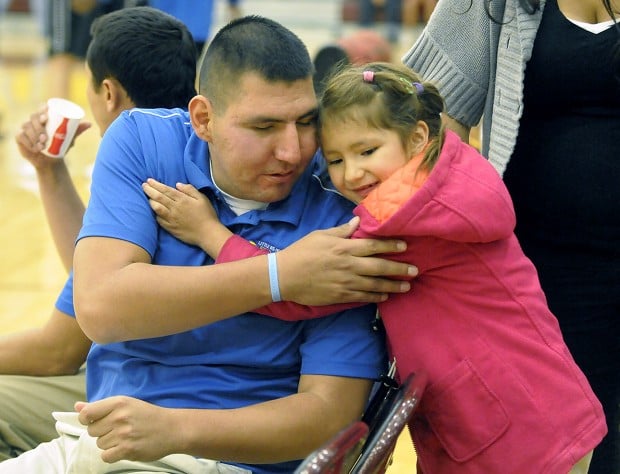
Chavez, 29, is now an assistant coach at Little Big Horn, the small tribal college of roughly 300 students in Crow Agency. His boss is 33-year-old Pete Conway, the former 3-point marksman for the Montana State Bobcats.
Conway, a Blackfeet Indian, and Chavez, who is Crow and Northern Cheyenne, have been friends ever since Conway hosted Chavez on a recruiting trip to Bozeman. Now the two are an all-too-rare sight: Native Americans who played Division I college basketball, graduated and are now coaching a team comprised mostly of Native Americans.
“It’s so cool how life travels in a circle,” said Chavez’s sister, Suzette Means, who has lived in Missoula ever since her brother first donned the maroon and silver, and who was in Pablo on Thursday to watch the Rams eke out an 87-84 exhibition win.
Chavez calls it “ironic, or a coincidence, I guess,” but you have to wonder if he wasn’t taking a little peek into his future that February night more than five years ago.
Chavez tried his hand at professional basketball after graduation from UM. He played for the Great Falls Explorers of the ill-fated CBA for a season, then played in a pro league in Mexico.
“When I left there, I kind of hung up basketball and I was teaching in Pryor, junior high and elementary, and coaching junior high boys’ basketball,” Chavez said, although anyone who knows him knows that Chavez still makes the summer circuit, playing in tournaments around the state. “I was doing that for a couple of years and was kind of between jobs this summer; my contract was up. I was looking at possibly doing something different as far as basketball is concerned, whether it be high school or college.”
Then he got a call from Conway.
“Mike grew up in the community there in Crow,” Conway said. “The things he was able to accomplish in basketball and in life, it’s great he was willing to come back and do this.”
Means says it was more than just an opportunity for a paycheck.
“It is like a Godsend,” she said. “Since he graduated he’s been wandering around, not quite sure what to do. When this came up, he thought he should take advantage of it because you don’t know when it will happen again.
“The players are so lucky to have those two. He’s loving it, especially from where he was a few months ago – he was mentally, emotionally and spiritually in the dumps. He has his glow back again.”
*****
Chavez admits that during his playing days coaching never really crossed his mind. In the last three or four years, though, he’d been approached about coaching at the high school level.
“I really wasn’t too into it just yet, but when this opportunity opened up it really intrigued me because I didn’t know that Little Big Horn was the only tribal college that competes in Division I junior college basketball in the nation,” Chavez said. “I thought that was pretty awesome.”
Among the men’s basketball programs in Region IX of the NJCAA are Sheridan College, Casper College and Western Nebraska, schools that routinely produce players who go on to play at the Division I level. Regional schools like Miles Community College and Dawson Community College are also in Region IX.
“I thought there wasn’t a better place to start than here,” Chavez said. “Me and Pete came out of good programs. With that experience and the coaches I’ve had in the past – whether it be Wayne Tinkle, Larry Krystkowiak – it gave me the opportunity to go show what they taught me.”
During his career at Montana, Chavez saw three coaching changes. Don Holst recruited him to Missoula, Pat Kennedy followed, Krystkowiak replaced Kennedy and finally Tinkle succeeded Krystkowiak.
“Krystkowiak was pretty huge in making me work hard – a lot less talking and a little more action,” Chavez said. “Tinkle has always been there – I went through four coaches while I was there – but Tinkle has always been the foundation, with support that was always there to help me out.”
And having a couple of big men as his mentors in Missoula has helped him become a better coach.
“Pete, when he played he was a great shooting guard,” Chavez said. “I played for post players – Coach K and Tinkle – they taught me a lot about the post game and different offenses. I’ve been able to use that to help these guys.”
Salish Kootenai College has its own former Native American Division I player on its bench in JR Camel, the former Griz who is an assistant to his brother Zach. The Bison took it to Little Big Horn in the first half Thursday, leading by as many as seven points when Polson’s Louis Mohr knocked down a 3-pointer.
But AJ Jackson Jr. of Kansas City started a 9-0 burst that gave Little Big Horn a lead that eventually grew to 49-40 at halftime.
“Over half our team is Native American, but we do have guys from Serbia and Bulgaria, and a guy from Kansas City,” Chavez said. “We’ve got a melting pot going on right now.”
In fact, when Little Big Horn wing Damyan Stoyanov was charged with a technical foul during the second half, Conway repeatedly asked the official what Stoyanov had said. Getting no reply, Conway finally shouted in jest, “He’s from Bulgaria. He doesn’t even speak English.”
The Rams didn’t take the lead for good until Stoyanov hit a trey with 69 seconds to play. Preston Gray of Ashland gave them some breathing room with a pair of free throws with 14 seconds left.
Gray, DL Singer of perennial Class B power Lodge Grass and Thane Gray of Havre are the three Montanans in the Rams’ starting five.
“I took advantage of the opportunity because I saw Pete play and I saw (Mike) play and they were good when they played,” Singer said of his decision to attend Little Big Horn. “I could have gone somewhere else, but these guys were tremendous players and I wanted to learn from them and try to follow in their steps.
“I watched them play a lot when I was little. They were kind of like my idols growing up. When I heard they were both going to coach and it was close to home, plus Pete said he’d give me a scholarship, I didn’t want to back down from that.”
*****
Being positive role models for young Native Americans is something both Chavez and Conway hope to nurture.
“It is because there’s kind of a long divide among college coaches and athletes on the reservation,” Chavez said. “I felt if I could come in and Pete could step in ... we’d be able to help a lot of these guys succeed. Basically coming in and giving them my experiences, so if they work hard enough and are fortunate enough to get to a four-year program they don’t come in like a deer in the headlights, like I was. To help them learn about not only basketball, but life.”
Having coaches who have already taken a road less traveled by Native Americans can only offer hope, Conway said.
“I think we hope that it sends a positive message: There are two Native Americans who went on to play at established Division I programs and graduated and got their degrees and now they’re back trying to help us get our degrees and move on to the next level or the next step in life,” Conway said.
Right now, Conway said, Little Big Horn will build its program around the best players it can find from Crow and the surrounding communities, along with whatever players happen to find Little Big Horn on their own, like Stoyanov.
“Eventually we want to make it the place where kids from other tribes and reservations want to come play college basketball,” Conway said. “If they don’t have a shot at a four-year school right away, we want to make it the destination that’s their No. 1 choice. Hopefully, one day we’ll be able to go out nationally to the other reservations and other tribes and reach out to them.
“Another one of our goals is to prepare them for the next step in life. The doors that getting their associate’s degree will open for them are a lot more than most people have. Whatever that next step in life is we want to prepare them for.”
Setting good examples can only help.
“He’s like an ambassador for Native people,” Means said of her brother. “If he succeeds, we all succeed.”